


Types of Gears: A Detailed Look
Can you tell the difference between a bevel gear and a helical gear? How about the advantages of cut metal vs. powdered metal? All gears are not the same. Here is some information on gears you should consider when talking to a motor manufacturer. For more help, look to our post on The Ins and Outs of Gears.
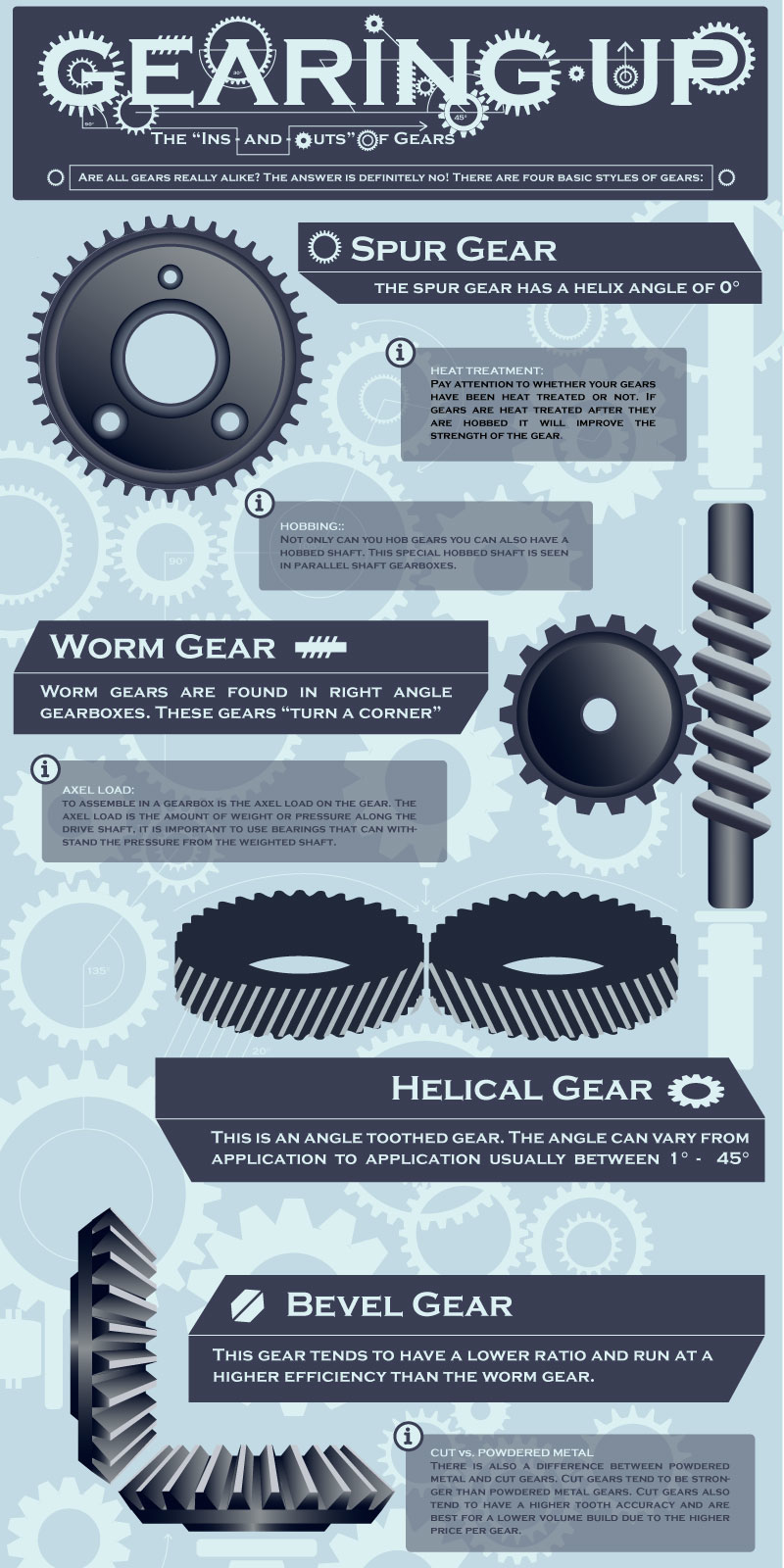
Types of Gears
Spur Gear: The spur gear has a helix angle of 0°.
Worm Gear: Worm gears are found in right angle gearboxes. They “turn a corner.”
Helical Gear: This is an angle toothed gear. The angle can range from application to application, usually between 1° and 45°.
Bevel Gear: Bevel gears tend to have a lower ratio and run at a higher efficiency than worm gears.
Additional Gear Information
- Pay attention to whether or not the gears have been heat treated. Gears that are heat treated after they are hobbed will have increased strength.
- Both gears and shafts can be hobbed, and a special hobbed shaft can be found in parallel shaft gearboxes.
- Axial load is the amount of weight or pressure along the drive shaft; it is important to use bearings that can withstand the pressure of the weighted shaft.
- There is a difference between cut and powdered metal gears. Cut gears have a higher tooth accuracy and tend to be the stronger gear option.
