

 Noise is often the single toughest challenge faced by design engineers when developing products for medical applications. Such was the case for a leading global company that designs, manufactures and installs patient lifts in healthcare facilities.
The Challenge
- A very quiet motor
- Ability to lift intermittent loads weighing up to 600 pounds
- Highly reliable and tested for performance at maximum load
- Long life
The Solution
- Permanent magnet DC motor customized for ultra-quiet operation
- Modifications to brushes and holders to reduce noise
- Noise levels averaging 42 dBA
- Tighter balance specification
The solution was ultimately a combination of adapting existing technology, selecting and testing a variety of materials, and adjusting manufacturing techniques that delivered the final product. Other adjustments were the armature balance and bearing tolerances. The balance tolerance on this project was cut to half the range of the standard product, and a more precision bearing was also employed to decrease the radiated noise.
Obviously, the motor needed to be powerful, reliable, and very quiet. It was the last requirement which was the toughest job. The inherent noise issue with many types of motors is the brushes. Brushes create mechanical and electrical noise due to friction against the commutator, as well as arcing caused by current conducting through the brush and commutator.
Reliability was a given, it was their desire to have the quietest possible motor for their mobility-impaired end users that was the driving force behind the engineering of this motor. A standard permanent magnet DC (PMDC) motor that is powerful enough to lift patients operates around 52 decibels (dBA). This is about the sound level in a room with a window air conditioner.
Groschopp engineers tried a variety of schemes to reduce the noise while still maintaining performance specs. A special varnishing process was used first to reduce the sound. Next, working with the carbon brush supplier, a brush was designed that would meet the noise and life requirement of the customer. In order to complement the brush design, additional machining tolerances were examined and tightened to achieve noise level reduction. It was ultimately a combination of adapting existing technology, selecting and testing a variety of materials, and adjusting manufacturing techniques that delivered the final product.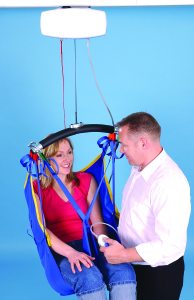
After a year of working on the design, Groschopp was able to meet the exact noise specifications. The motor normally operates around 52 dBA, but after five prototypes, thorough testing in the sound lab indicated we were operating at an average 42 dBA.
This reduction in noise level of some ten decibels was an impressive achievement. The decibel scale is logarithmic, not linear. Every three dB decrease of the sound level cuts the intensity of the sound by half. At 42 dBA, the sound is only marginally louder than a private office or quiet room.
