


DC motors are among the most common types of motors used in low voltage and high starting torque applications. You’ll often find them in many industries and applications where reliability and durability are essential. In this article, you’ll learn the basics of DC motors, with a focus on permanent magnet DC motors. We’ll cover how they work, their main components, key characteristics, advantages, disadvantages, and much more.
- Watch our DC motor overview and selection video.
What is a DC Motor?
A DC motor is a motor that converts direct current (DC) electrical energy into mechanical energy. It does this by using magnetic fields generated by electric currents to create torque, which causes the rotor to spin.
Unlike AC motors that use alternating current or brushless DC motors that rely on electronic controllers, traditional DC motors use brushes and a commutator to maintain continuous rotation. This simplicity makes DC motors easy to control and widely adaptable.
DC Motor Construction and Operation
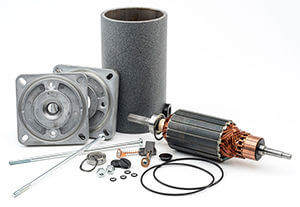
A PMDC motor is comprised of several key components:
- A wound armature
- Commutator
- Brushes
- Permanent magnets housed inside a motor housing
Electricity flows from the power source into the motor through the brushes. The brushes press against the commutator, passing current into the armature windings. As current flows through these windings, it creates a magnetic field around them. This field interacts with the fixed magnetic field from the permanent magnets, generating a force on the armature and causing it to rotate. The commutator helps switch current through the armature windings as the motor rotates, allowing the motor to keep producing torque in the same rotational direction.
DC Motor Characteristics
- Runs on DC power or AC line voltage with a rectifier
- Typical operating speeds of 1,000 to 5,000 rpm
- 60-75% efficiency
- High starting torque
- Linear speed-torque relationship
DC Motor Advantages & Disadvantages
Advantages
- Operates on DC power supply without a control
- Inexpensive controls for speed regulation
- Generally a low-cost motor option
- Easily pairs with gear reducers
Disadvantages
- High maintenance due to low brush life (2,000 hrs max in continuous duty applications)
- Cogging at speeds of less than 300 rpm
- Significant power loss on full wave rectified voltage
- High starting torque can damage reducers
DC Motor Performance Curves
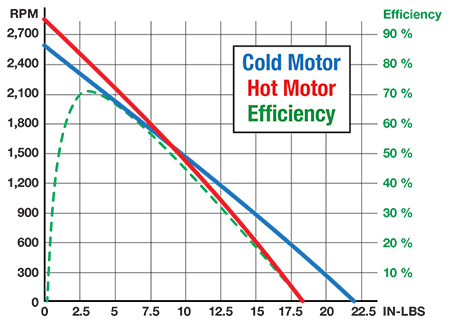
Here we have the typical speed-torque curve of the PMDC motor.
Looking closely, we can see an interesting phenomenon with the hot motor curve. As the motor temperature rises, the no-load speed also increases. This is due to the effect heat has on the windings. As the motor cools down (to room temperature), the speed will return to normal. The same concept applies to the other end of the curve, where stall torque is reduced for a “hot” motor. Notice the efficiency curve and how, under ideal circumstances, the motor’s peak efficiency will occur near the motor’s operating torque.
DC Motor Control Basics
PMDC motor controls are used to adjust motor speed by varying the voltage supplied to the motor. As the applied voltage changes, motor speed changes as well.
Two common types of motor controllers are:
- SCR controllers (silicon-controlled rectifier): These controllers regulate the voltage supplied to the motor.
- PWM controllers (pulse width modulation): These controllers control motor speed by rapidly switching power on and off to adjust the average voltage delivered to the motor.
Applications of DC Motors
DC motors are found in a wide range of applications, including:
- Handheld Power Tools
- Household Appliances
- Conveyor and packaging machines
- Pumps
- Fitness and recreational equipment
- and many other types of equipment and applications.
Their versatility, especially their ability to run on portable or remote DC power supplies, makes them popular across many sectors.
Summary / Wrap Up
DC motors offer an affordable, versatile motor solution with strong starting torque and flexible power supply options. Understanding the basics of DC motor operation, characteristics, and control can help you choose the right motor for your application. If you need help selecting the right DC motor, our team can help you evaluate your requirements and identify the best fit.
Need to save this for later? Download the DC Motor Basics PDF Guide to share with your team or keep a copy for yourself.
