
Fractional HP Motors and the Problem with Single Load Points

January 29, 2014

Compare DC Motors

Sometimes single load points, or rated load points, are the only data available when determining the specifications of a fractional hp motor. In order to better explain why one load point isn’t typically enough to select a motor, we’ll compare two different sample motors to show the variations and why it’s important to know the range of load points within an application.

(For this discussion we’ll focus on Permanent Magnet DC (PMDC) motors due to the linear nature of speed versus torque and ease of explanation; however, this principle holds true for AC motors and Brushless motors as well.)

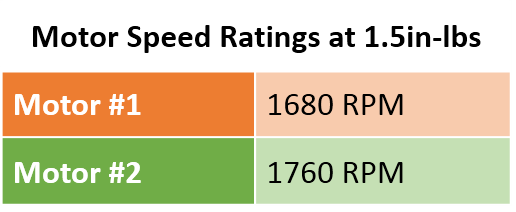
First, the application’s designed load point is 1.5in-lbs at 1700 RPM.
When selecting a fractional hp motor for your application be sure to let your motor manufacturer know if you will have varying load points, as it can affect the design and size of the motor.

According to the ratings, both of these PMDC motors will work for the application.  The speed of both motors are the tested speeds, but know that it’s common to have some slight deviation from the target speed, in this case 1700.

However, if it’s determined that, in reality, the application has variations and the actual load may get as high as 3in-lbs but the speed cannot vary more than 10-15% through the load range. Will both motors still fit the application?

When selecting a fractional hp motor for your application be sure to let your motor manufacturer know if you will have varying load points, as it can affect the design and size of the motor.

As the ratings show, only motor #2 will fit the application requirements.   The torque versus speed plot of both motors confirms the ratings by showing the drop in speed as the torque increases for each motor.

One load point is not enough to determine a motor's ability to operate properly within an application.

We can safely assume Motor #2 is larger than Motor #1, evidenced by the slope of the speed/torque lines. Motor #1 has a rated peak output of .05 hp and motor #2 has a .3 hp rated peak output. Motor #2 experiences less speed loss with increases in torque; thus, Motor #2 will be the best fit for the application.

When selecting a motor for your application, be sure to let your motor manufacturer know if you will have varying load points, as we’ve seen it can affect the design and size of the motor.

Check out our white paper for more information about selecting a motor.

How to use the Motor Search Tool

Narrow your search by selecting motor type, gearbox, voltage, and phase options for your desired motor.

Select a dominant variable: choose one of the three parameters to narrow your search. The selected variable determines which slider bar you will be able to manually move.

Use the slider corresponding to your dominant variable to further narrow your motor selection. The other sliders will automatically move to show available ranges based on the range of your selected variable.

Results will upload as your search criteria changes. If you have any questions regarding your results or how to use the search tool, you can chat with us using the green tab on the left-hand side of your screen.


Note: Groschopp Universal motors are custom built to fit your application so no additional options are available to narrow the search. Selecting the Universal motor type will prompt a message taking you to the Universal product page.

Not sure what you need?

One of our team members would be happy to help. Contact us at 800-829-4135 or by email at sales@groschopp.com. You can also chat with us using the green tab on the left side of your screen.

send us an email

Universal Motors

Groschopp Universal motors are custom built to fit your application so no additional options are available to narrow the search. Standard frame sizes and motor features can be found on the Universal page.

go to Universal page