


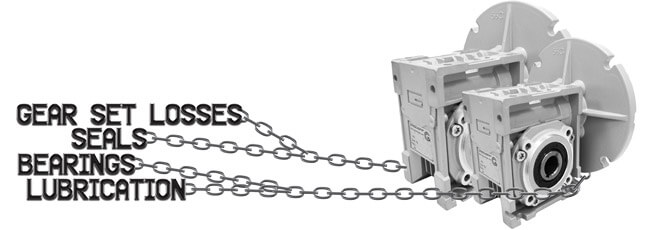
Load capacity, usable life, envelope size, and cost: all are very important considerations when designing a gearbox. However, accurately accounting for gearbox efficiency losses is a frequently forgotten element of the design process. These losses can be attributed to several factors: gear set losses, seals, bearings, and lubrication.
Gear Set Losses
Depending on the type of gear set, efficiency losses may have a minor or major impact. Spur, helical and bevel gears will have losses from 0.5%–3% while face gears and beveloids may experience losses up to 5%. Hypoids and planoids will lose efficiency by 2%–10% percent. Gear sets that may exhibit considerably higher efficiency losses include: crossed helicals with 5%–50%; cylindrical worms and high reduction hypoids with 10%–50%; double enveloping worms and helicons with 2%–50%; and spiroids with 3%–50%. (Townsend, Dennis P. Dudley’s Gear Handbook. The Design, Manufacture, and Application of Gears. Second Edition. McGraw-Hill, Inc., 1991, 1962.)
Seal Losses
Seals are used to keep lubrication from escaping the inside of a gearbox as well as to keep outside agents from entering the gearbox. Static seals used between housing members have no impact on gearbox efficiency. Dynamic seals, however, do impact efficiency because they make contact on a rotating member, typically the shaft. As the shaft rotates inside a stationary seal, efficiency is lost through friction and heat. To reduce the effect of friction, lubrication is applied between the shaft and seal. It is important to note that different seal types will impose differing amounts of drag on a shaft. For example, a double-lip shaft seal will have a higher level of ingress protection but will impose more friction than a single lip seal. An application that uses an o-ring as a rotary seal will likely experience higher losses than a double-lip shaft seal.
Bearing Losses
Bearings come in many different types and styles. The most efficient are roller-type bearings that do not contain seals. Many different varieties of seals can be added to a roller bearing; doing so will likely add some degree of drag thereby lowering the overall gearbox efficiency. Many different types of bearing greases are also available and may impact efficiency depending on the grease viscosity. Other, slightly less efficient, bearing types include: powdered metal bronze, iron bushings, and molded plastic bushings.
Lubrication
Gearboxes are lubricated with either grease or oil. Many variations of grease and oil exist with qualities such as: high temperature, low temperature, extreme pressure, water resistance, corrosion protection, etc.. One key factor that may impact gearbox efficiency is the viscosity of the lubricant. As lubrication becomes more viscous or “thicker”—due to falling temperatures—more resistance is introduced within the gearbox thereby making it less efficient. The opposite is true when temperatures increase; the lubricant’s viscosity lowers becoming “thinner” thereby increasing the gearbox efficiency. Lubrication fill, or how much lubrication is added to the gearbox, also affects efficiency. Too much lubrication in a high speed gearbox will cause a churning action that produces excessive heat and efficiency loss; however, not enough lubrication will allow for excessive wear on the gear set.
Conclusion
Gear set, seal, bearing, and lubrication losses have a direct effect on the power required to drive the gearbox. When a larger motor is needed to overcome efficiency losses in the gearbox, that ultimately raises the overall cost. How can one anticipate the how these factors affect gearbox efficiency during the design process? This can be a difficult question to answer. Depending on the gearbox being designed, gear set losses can be fairly predictable based on the research and experience. Seal, bearing and lubrication losses are more difficult to predict. At times, these losses may be negligible if designing a large, high load capacity gearbox. However, when designing a fractional horsepower gearbox, the seal, bearing, and lubrication losses may have a significant impact. Therefore, testing—especially at various temperatures—is crucial. Just because a gearbox performs well at ambient temperature, does not mean it will have the same performance at -40°C or +150°C. All variables must be considered.
>>Need help selecting the right gearbox? Read our blog on selecting the right gearbox for your application. Or submit your application specs and we’ll contact you to discuss your best solution.
