

There are many diverse applications for electric motors today with plenty of applications that are trying to control a certain aspect of the motor, whether it is speed, torque or position.
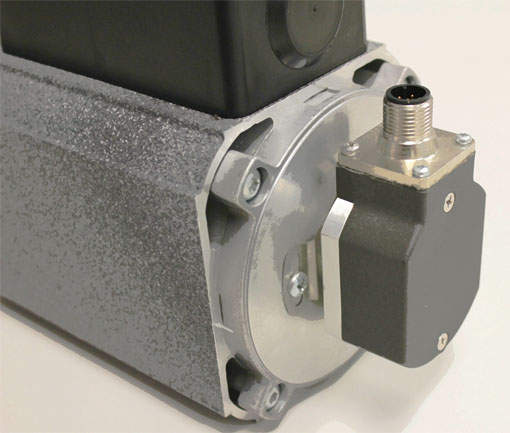
Many of the sophisticated motor drives on the market can regulate speed and torque to some degree by controlling the voltage and current available to the motor. In cases that require more precise control, a feedback device can be added to the system in order to “close” the loop. A feedback device is simply something that reports its status back to a controller. The oldest example is if you touch something hot, a nerve transmits a signal to your brain to tell you it is hot and to move your hand.
Here we are highlighting a couple different feedback devices to help you understand what they do and what questions you may want to ask when you call Groschopp.
Hall Effect
One of the simplest feedback devices is a Hall Effect sensor. A Hall Effect sensor will switch on and off in the presence of a switching magnetic field. If a two pole magnet is placed in line with the Hall Effect sensor and the motor shaft is rotated, you will see the output of the sensor go high and then low. This will result in one cycle per revolution. The number of pole pairs can be increased based on the diameter of the magnet and, in turn, the resolution will be increased. A Hall Effect sensor will only provide speed information.
Incremental Encoders
The next type of feedback device to be considered is an encoder. There are several different approaches that generate encoder feedback; such as, optical, magnetic, and capacitive encoders. Encoders can perform the same function as a Hall Effect, but with more information in the output. A typical incremental encoder will provide two outputs as compared to the single output of a Hall Effect sensor Using two outputs that are out of phase with each other allows you to determine the direction of rotation and you have 4 times the resolution. In general, encoders allow you much higher resolutions than the Hall Effect.
Absolute Encoders
One negative of the incremental encoder, is that if a power loss occurs, the encoder wont know where it is when power is restored. The simplest way to solve this is to use an absolute encoder in your application. Absolute encoders are, “absolute”. The strategies for making an encoder absolute vary, but when you power the encoder “on” it will give you a position with in a 360° window. This type of encoder would be called a single turn absolute encoder. There are also multi-turn absolute encoders if your application requires it.
This is a quick comparison of a couple different feedback device options. All feedback options will have a different cost depending on your performance requirements. The most important thing in helping you select the right feedback device is understanding your individual application.
